

With fixed-price or seat-based subscriptions, the amount a customer pays is usually relatively predictable. Usage-based billing changes that. Revenue may now depend on API calls, AI tokens, inference, compute, transactions, agent actions, credits, commitments, overages, or outcomes.
Each billable event has to make it through a revenue chain:
And a correct invoice does not necessarily mean you captured all the revenue you earned.
Revenue can disappear anywhere along that journey. Usage may never reach billing. The right usage can be rated at the wrong price. Credits and commitments can get out of sync. A contract change may never reach the rating engine. And correctly billed revenue can still create problems downstream in revenue recognition.
For SaaS and GenAI businesses, billing accuracy is only part of the picture. The bigger question is whether what was consumed, what should have been charged, what was billed, and what ultimately became revenue all stayed connected.
Usage events never reach billing
API calls, AI tokens, inference workloads, agent actions, transactions, and other consumption events originate outside the billing system.
Before they can become charges, those events have to be captured, validated, associated with the right customer and service, and prepared for rating.
Events can be dropped during ingestion. The same event can arrive more than once and be processed again. Late events can miss a billing period. An event can also arrive without the customer, product, or usage attributes needed to price it correctly.
AI makes this particularly important. A single user request can trigger multiple model calls, tool invocations, or agent actions. What looks like one customer interaction may produce many underlying consumption events.
Billing cannot charge for an event it never receives.
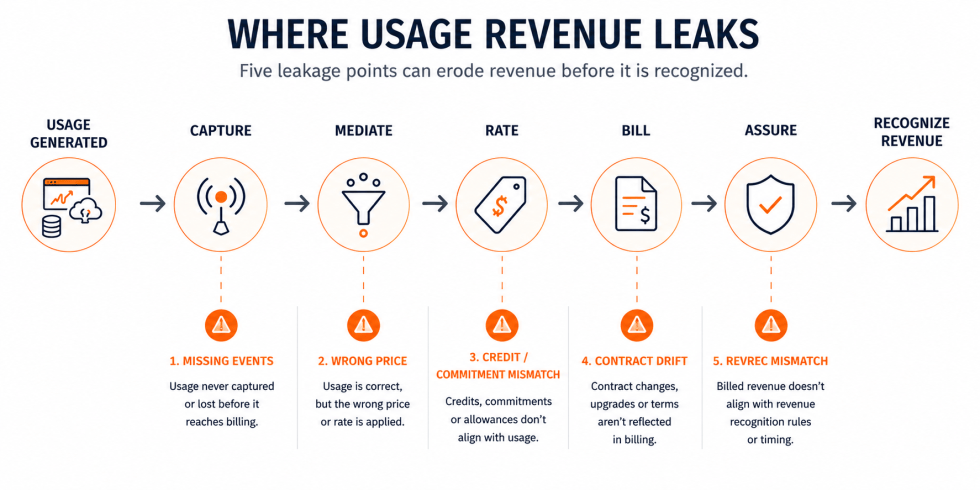
The usage is right. The price is wrong.
Capturing usage correctly does not guarantee revenue accuracy.
An AI event might be priced according to the model used, token type, customer contract, volume tier, or commitment. An API transaction may depend on the endpoint, customer tier, included allowance, and overage rate.
That means two customers can consume exactly the same quantity and legitimately owe different amounts because their contracts, commitments, discounts, or pricing tiers are different.
Revenue leaks when the usage event is correct but the wrong commercial rule is applied. An expired rate may remain active. The wrong volume tier may trigger. A discount may persist beyond its agreed term. Usage may map to the wrong product or customer-specific rate.
This becomes more important as SaaS and AI companies move beyond simple subscriptions into combinations of recurring, usage, credit, commitment, and outcome-based pricing.
Credits, commitments, and overages do not reconcile
Hybrid models are increasingly useful for SaaS and GenAI because they combine predictable committed revenue with flexible consumption.
A commercial model might look like:
That may be simple for the customer to understand, but behind the scenes the contract, entitlement, usage, credit balance, and billing all have to remain synchronized.
A customer can consume the service correctly while the wrong credit pool is depleted. An overage may fail to trigger. Credits may expire incorrectly. Usage may continue beyond an agreed limit. Or a customer may be charged for consumption that should have been covered by a commitment.
The challenge is not simply counting usage. It is keeping usage, entitlements, commitments, credits, and billing aligned.
The contract changed. Billing did not.
This is one of the most overlooked revenue leaks in B2B SaaS.
A customer expands. A discount expires. Included usage changes. A new AI service becomes billable. An amendment introduces a different rate, credit allocation, or commitment.
The commercial agreement changed. Did the revenue system change with it?
If quoting, contracts, provisioning, usage, and billing operate independently, an amendment can be correct in CRM and still never reach the rating engine.
For example, a customer could move from a platform fee with 5 million included tokens to a higher platform fee with 10 million included tokens and a discounted inference overage. The quote can be correct, the contract can be correct, and the service can be provisioned correctly, while billing continues to apply the old overage rate.
This creates contract drift: what the customer agreed to and what the revenue system actually applies begin to diverge.
Usage-based monetization is therefore not only a billing problem. It is a commercial-to-revenue continuity problem.
The invoice is correct. Revenue recognition is not.
Billing answers what should we charge? Revenue recognition answers when and how should that revenue be recognized?
Those are not always the same thing.
A SaaS or AI contract may combine a recurring platform fee, prepaid commitment, usage charges, credits, and professional services. Usage may be billed in arrears while another portion of the agreement was prepaid.
As monetization models become more flexible, the connection between consumption, billing, and revenue recognition becomes increasingly important. A clean invoice does not automatically mean a clean financial close.
Revenue assurance is becoming essential for usage-based SaaS and AI
The five leaks have something in common: none can be solved simply by checking whether the final invoice adds up.
As SaaS and GenAI move from fixed subscriptions toward tokens, APIs, compute, agent actions, credits, commitments, and outcomes, they are becoming event-driven revenue businesses. Revenue now depends on a series of connected systems and decisions between consumption and accounting.
That is where revenue assurance becomes relevant.
Did we correctly bill the usage we received?
Did every valid revenue event that should have been captured and monetized actually become revenue?
A billing engine can accurately process everything it receives. Revenue assurance looks across the journey for what may have been lost, mispriced, or disconnected.
Telecom companies have dealt with this class of problem for decades because revenue has long depended on large volumes of usage events. SaaS and AI now face a similar structural challenge, even though the units have changed from calls and data to API requests, tokens, compute, and agent actions.
How OneBill connects usage to revenue
OneBill connects the commercial agreement to the usage and revenue lifecycle, helping SaaS and GenAI businesses keep what was sold, what was consumed, what was billed, and what became revenue connected.
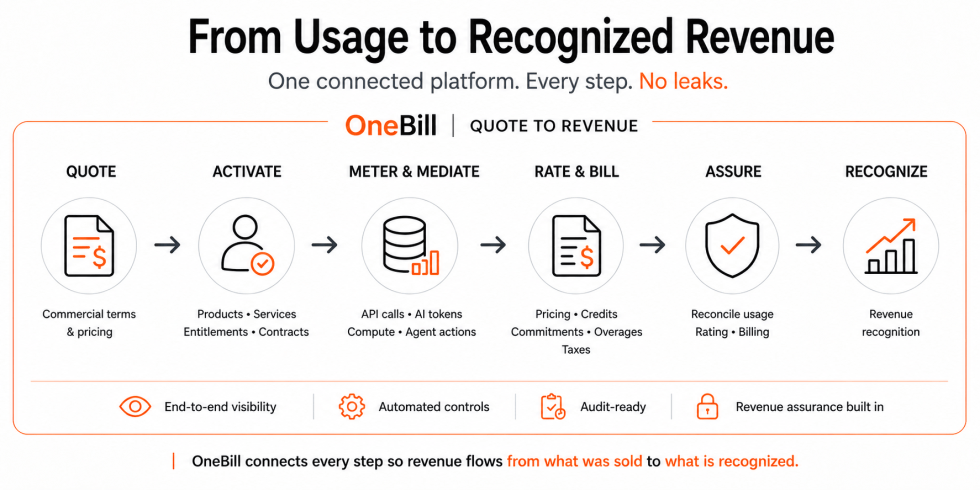
The objective is straightforward: keep what was sold, what was consumed, what was billed, and what became revenue connected.
Explore how OneBill helps SaaS and AI businesses turn complex usage into accurate revenue.
See how OneBill can connect commercial terms, usage, rating, billing, assurance, and revenue operations around your business model.
Book a DemoContinue exploring usage-based monetization
Usage-Based Billing Software
Meter, mediate, rate, and monetize usage across SaaS, AI, telecom, and other consumption-driven businesses.
Explore usage-based billing →SaaS, GenAI & Datacenter Billing Software
Monetization for API usage, AI tokens, compute, and other SaaS and AI consumption models.
Explore SaaS & AI billing →Usage-Based Hybrid Billing for SaaS & GenAI
Combine subscriptions, usage, commitments, credits, and overages.
Explore hybrid billing →Outcome-Based Consumption Pricing for AI Agents
Explore pricing models built around AI agent activity and outcomes.
Explore outcome-based pricing →